Racial Justice
Asian American and Pacific Islander communities, and all communities of color, deserve to live in a world free from harmful stereotypes, hate, and racism.
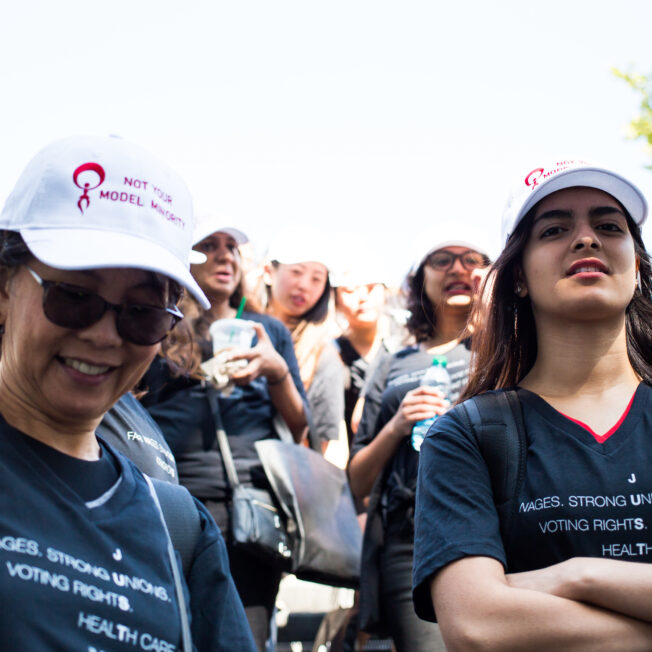
As Asian Americans and Pacific Islanders (AAPIs), we are all too familiar with facing barriers and discrimination based on who we are and where we or our families come from.
AAPI women are forced to live with stereotypes that take away our humanity and reduce us to sexualized objects. Caught in this intersectional web of racism, sexism, and dehumanization, AAPI women have reported two to three times more instances of violence and harassment than men.
To this, we say no more.
AAPI women deserve safety in public spaces. And in the fight to take back our humanity, we seek to tackle the root causes of racism and white supremacy in solidarity with other communities of color so that everyone is free from racial and gender oppression.
Factsheet: the 2025 State of Safety
FBI data from 2024 show that while anti-Asian hate crimes have decreased from their 2022 peak, they remain nearly three times higher than pre-pandemic levels, underscoring the persistence of racialized violence against Asian American and Pacific Islander (AAPI) communities and the urgent need to enact protective policies that safeguard their democracy, foster their sense of belonging, and improve their public health. Read more in our 2025 factsheet→
Report: The State of Safety for Asian American, Native Hawaiian, and Pacific Islander Women (2022)
This groundbreaking survey conducted from January and February 2022 spotlights Asian American, Native Hawaiian, and Pacific Islander (AANHPI) women’s experiences with discrimination, harassment, and violence amidst the COVID-19 pandemic and one year after the mass shootings in Atlanta that claimed the lives of six Asian American women.
The racialized misogyny faced by AANHPI women is not limited to hate incidents, but also includes experiences with different forms of harassment. AANHPI women are continuously fetishized, exoticized, and objectified through hyper-sexualization, affecting the racialized, gendered, and sexualized violence AANHPI women experience, historically and now. Even prior to the pandemic, AANHPI women experienced a great deal of violence and discrimination at the intersection of race, ethnicity, gender, immigration status, and socioeconomic class, among many other factors. Read more in the full report→