Economic Justice
AAPI women deserve dignity and equal pay at work so our families and communities can thrive.
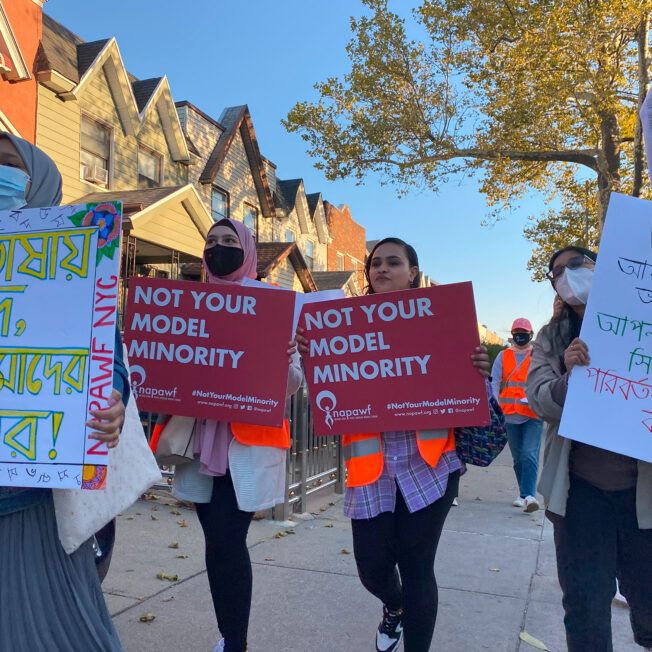
We are not your model minority.
Too often, mainstream conversations about economic injustice misrepresent AAPI communities. The dangerous ‘model minority’ myth stereotypes and falsely characterizes Asian Americans as having achieved economic stability and security while pitting communities of color against each other.
At NAPAWF, we are working to break these damaging stereotypes by illuminating the lived experiences of AAPI women.
AAPI women are overrepresented in frontline and low-wage positions, especially in the retail, restaurant, and personal care industry. Millions of AAPI mothers live in multigenerational households, shouldering the brunt of caregiving not just for their children, but for elderly parents and extended family members too.
Our research shows that Thai, Vietnamese, Pakistani, Tongan, Bangladeshi, and Nepalese women face some of the highest wage gaps. Our studies reveal that poverty rates for AAPI seniors are three to five percent higher than the national average. For AAPI women relegated to low-wage industries, longer hours and multiple jobs do not guarantee fair pay, let alone paid family or medical leave.
Economic justice lies at the intersection of racial, reproductive, and gender-based justice — and it is the key to working with dignity, providing for our families, and having the agency to direct our own lives. That’s why we at NAPAWF are raising awareness of AAPI socioeconomic diversity, increasing our community’s economic opportunities, and closing the wage gap for AAPI women and girls. Through our efforts, we believe we can give every Asian American and Pacific Islander the chance not just to survive, but to thrive.
The Wage Gap for Asian American, Native Hawaiian, and Pacific Islander Women
On average, Asian American, Native Hawaiian, and Pacific Islander (AANHPI) women earn 83 cents for every dollar paid to white, non-Hispanic men.
However, disaggregated data reveals that many women experience much larger wage gaps, particularly Southeast Asian, Native Hawaiian, and Pacific Islander women.
Every year, NAPAWF leads a day of advocacy for AANHPI Equal Pay Day to recognize the continued inequality in pay that AANHPI women face.
Clocking Inequality: Understanding Economic Inequity, the Wage Gap, and Workplace Experiences of AANHPI Women
Clocking Inequality is a report that explores how historical shortcomings in data collection efforts have created a disconnect that prevents Asian American, Native Hawaiian, and Pacific Islander (AANHPIs) women and immigrants from achieving economic mobility.
Overall, caregiving emerged as a key priority needed to improve economic outcomes for AANHPIs, especially for smaller Asian American communities, as well as Native Hawaiian, Pacific Islander, and Indo-Caribbean women. Protections and systems of support tailored to AANHPI immigrants in the workplace and at home, combined with adequate support writ large for all caregivers, will help equitably address the wage gap and advance economic mobility.
Our policy recommendations emphasize the need for culturally informed solutions, targeted funding, and multi-sector collaborations. Read more→
Long-Term Unemployment Among Asian American and Pacific Islander Women
Government data revealed that AAPI women experienced the highest rates of long-term unemployment of any racial/ethnic groups in the U.S. in 2020. Read our factsheet→